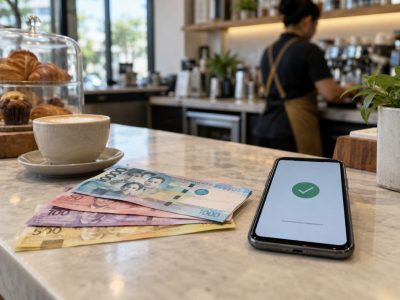
 Digital payments now make up most retail transactions in the Philippines, yet physical money remains firmly in circulation. The Bangko Sentral ng Pilipinas reported that electronic payments accounted for 64.69% of retail transaction volume in 2025, up from 57.45% in 2024. That looks like a clear move away from cash, but the currency story is more complicated.
Recent research from the Bangko Sentral ng Pilipinas found a negative long-run relationship between digital payments and total cash demand using Philippine data from late 2019 to 2024. The effect was strongest for ₱500 and ₱1,000 notes. For smaller denominations, including ₱20, ₱50, ₱100 and ₱200, the relationship was either insignificant or weakly positive. Digital payments appear to replace some cash uses faster than others.
Why Does Digital Growth Reduce Some Cash Demand?
Digital payments are convenient for transfers, bills and larger purchases. They reduce the need to withdraw a large amount of cash before completing a transaction. The same BSP study found that broader electronic financial activity had a stronger relationship with falling cash demand than QR payments alone.
This pattern fits the rapid expansion of digital commerce. The BSP says merchant payments represented 74.31% of electronic payment transactions in 2025. QR Ph transaction volume also rose sharply, showing how phones and account-to-account transfers are becoming routine for everyday spending.
Small Notes Tell a Different Story
Cash still works well for low-value, face-to-face transactions. Public markets, transport fares and neighborhood purchases often involve amounts where change matters. The Bangko Sentral ng Pilipinas created Paleng-QR Ph partly because market vendors, community shops and tricycle operators remain important parts of the country’s everyday payment system.
Research from the World Bank also notes that small merchants can face barriers to digital acceptance, including thin margins, onboarding costs and service fees. Digital access therefore does not automatically mean every seller or buyer prefers electronic payment for every transaction.
Cash Is More Than a Payment Tool
Banknotes also serve as savings and contingency money. The BSP research notes that currency in circulation can include cash held as a store of value or for emergencies. That helps explain why physical money may remain attractive even when fewer transactions require it.
Cash also works without a phone, electricity, mobile data or access to a particular platform. A speech published by the Bank for International Settlements highlighted the continuing importance of cash in Philippine areas where mobile access or signal quality is poor. Digital options offer speed and remote transfers, while cash remains useful when connectivity is limited.
Less Cash Does Not Mean No Cash
The evidence points toward a cash-lite system rather than a fully cashless one. Digital payments are taking a larger share of transactions, especially where convenience is strongest. Yet smaller notes, emergency reserves and cash-dependent corners of the economy continue to create demand.
The likely future is therefore mixed. Cash may become less dominant, while remaining useful for specific transactions and circumstances. The paradox disappears once cash is viewed as several tools at once, rather than simply an older version of digital money. That distinction matters for central banks planning currency production and payment infrastructure.